Marketing Attribution for Sales Funnels: Connect Source to Revenue
Build practical marketing attribution for sales funnels by connecting campaign, lead, meeting, opportunity, and revenue records without overstating certainty.
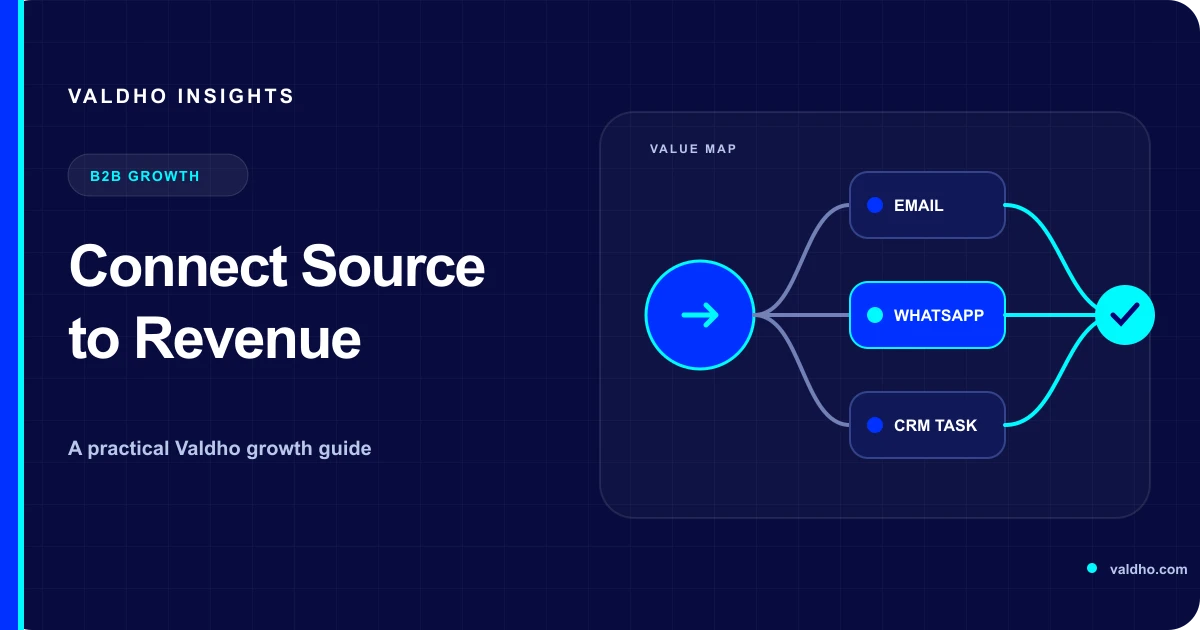
Marketing attribution for sales funnels is the discipline of connecting an acquisition signal to the business outcomes that follow without pretending every touchpoint is fully observable. For a service business, the useful path rarely ends at a form submission. It may continue through qualification, a booked meeting, an attended meeting, a proposal, a sale, and later adjustments such as cancellation or refund.
The goal is not to discover one perfect source field. It is to build a traceable decision system that shows what is known, what was assigned by a model, what is missing, and which record supports each outcome. That distinction helps small marketing and sales teams compare channels, investigate gaps, and change budget or process with appropriate confidence.
1. Define the decisions attribution must support
Begin with the decisions your team actually makes across a B2B lead generation funnel. A weekly channel review, a campaign pause, a landing-page test, and a sales follow-up change require different evidence. Write the decision, owner, review cadence, eligible outcomes, and minimum confidence before choosing reports or tools.
- Acquisition: which source and campaign produced eligible visits or responses?
- Qualification: which efforts produced accepted leads under the same fit rules?
- Meeting: which leads booked, attended, canceled, or did not attend?
- Pipeline: which accepted leads became active opportunities or proposals?
- Revenue: which opportunities produced verified sales, adjustments, or refunds?
- Operations: where did ownership, follow-up, or data capture break the chain?
2. Create a source-to-revenue contract
Write one shared contract for identifiers, stage definitions, time fields, ownership, and permitted values. The contract should state which system is authoritative for each outcome. Web analytics may be the reference for a session, while the CRM is the reference for an accepted lead, the calendar for a confirmed meeting, and the billing or finance record for realized revenue.
- Use an immutable lead or contact identifier that can travel through approved integrations.
- Record first-known source, current-session source, and conversion-credit fields separately.
- Keep campaign ID and campaign name rather than relying on a display name alone.
- Store stage timestamps such as lead created, qualified, meeting booked, meeting held, and sale recorded.
- Document duplicate, test, spam, cancellation, no-show, lost, refund, and reopened rules.
- Record the rule version so historical results can be interpreted after definitions change.
Do not put raw personal details into campaign parameters or public URLs. Decide what identifiers and customer data may move between systems with the people responsible for privacy, security, and platform terms. Attribution design should minimize data movement rather than copy every available field into every tool.
3. Standardize campaign capture at the entry point
Google Analytics' current custom campaign URL guidance explains how UTM parameters identify source, medium, campaign, campaign ID, and creative context. It also notes that parameter values are case sensitive. Create a controlled naming table, use lowercase values, assign one owner, and test the final destination after every redirect.
- Define allowed source and medium values instead of inventing them per campaign.
- Give each campaign a durable ID that remains stable when its display name changes.
- Use content values only when the distinction will support a real decision.
- Preserve click and campaign parameters through redirects and form completion.
- Capture the landing page and entry timestamp beside the source fields.
- Create a fallback state such as unknown rather than silently guessing a source.
Interpret analytics fields at the correct scope. Google's current guide to traffic-source dimension scopes distinguishes first-user, session, and event-scoped acquisition information. A first-user source answers a different question from a session source, so avoid placing both under one unlabeled Source column.
4. Preserve the chain through forms, CRM, and meetings
When a form creates or updates a CRM record, copy the permitted campaign fields, landing context, and capture timestamp into clearly named properties. Then attach later states to the same lead or opportunity. A meeting should reference the lead that booked it; the attended or no-show status should come from the agreed calendar or meeting record, not from a marketing guess.
- Valid submission creates one lead and retains the expected source fields.
- A repeat submission updates according to the documented overwrite rule.
- A booking connects to the intended lead without creating an unexplained duplicate.
- Reschedule and cancellation preserve history instead of rewriting the original event.
- Attendance is recorded under one consistent definition and time zone.
- Opportunity and sale records retain their link to the originating lead or account.
5. Treat models as decision lenses
Google's current attribution overview explains that attribution models determine how credit is assigned across touchpoints, that Google Analytics uses data-driven attribution by default, and that its model-comparison report can show how different choices change channel valuation. Use model comparison to test sensitivity, not to manufacture certainty.
For each report, label the model, eligible channels, lookback window, event date basis, cohort definition, currency treatment, and extraction date. Keep platform-attributed results beside operational counts rather than combining them into one number. A channel can receive modeled credit for a sale while the CRM still records one distinct opportunity and one distinct sale.
Time settings can change the visible path. Google's current guidance on the key event lookback window says the window determines how far back a touchpoint remains eligible for credit and that changes apply going forward. Align the chosen window with the buying cycle you are reviewing, record it in the report, and avoid comparing periods governed by different settings without a note.
6. Bring qualified and closed outcomes back carefully
For teams that advertise with Google, the current enhanced conversions for leads implementation checklist calls for distinct conversion actions for offline stages such as qualified and converted leads, accurate conversion times, consistent uploads, diagnostics review, and a transaction or order ID for deduplication in supported implementation paths. Treat those items as an implementation checklist for that platform, not as a universal CRM design.
Before any downstream outcome is shared with an advertising platform, define the eligible stage, required evidence, adjustment behavior, deduplication key, upload owner, error queue, and reconciliation report. Start with observation and diagnostics. Do not let a new imported signal drive automated budget decisions until the team has verified coverage, timing, duplication, and stage quality.
7. Reconcile with a source-to-revenue ledger
Build a weekly or monthly ledger with one row per channel and campaign, plus an unknown row that is never hidden. Include eligible visits or responses, valid leads, accepted leads, booked meetings, held meetings, opportunities, verified sales, adjustments, and revenue under one cohort definition. Show raw counts before rates and keep model-assigned credit in separate columns.
- Coverage: what share of eligible business outcomes has a usable acquisition record?
- Continuity: where do identifiers or relationships disappear between systems?
- Latency: how long does each stage take to arrive and mature?
- Duplication: which events, leads, meetings, or sales appear more than once?
- Mismatch: which totals differ because definitions, filters, windows, or time zones differ?
- Unknowns: which outcomes cannot be assigned without an unsupported assumption?
Sample individual paths behind every material conclusion. A totals match can hide incorrect pairings, while a totals mismatch may be fully explained by timing, eligibility, or adjustments. Keep a reconciliation note with the query date, filters, known gaps, and unresolved exceptions so the next review starts from evidence rather than memory.
8. Use confidence levels for budget and process decisions
Assign each conclusion a confidence level. High confidence might require verified sales records, stable identifiers, mature cohorts, consistent definitions, and small explained gaps. Medium confidence may support a controlled test but not a large budget shift. Low confidence should create a measurement or process task before it creates a channel verdict.
- High confidence: verified outcome, traceable path, mature window, and reconciled exceptions.
- Medium confidence: useful directional pattern with a documented coverage or timing gap.
- Low confidence: missing identifiers, changing rules, immature outcomes, or unexplained mismatch.
- Decision rule: match the size and reversibility of the action to the strength of the evidence.
- Review rule: state what new evidence would confirm, revise, or reject the conclusion.
For a small team, the best attribution design is one people can operate consistently. Review how the process assigns campaign names, lead owners, meeting states, sales stages, exception handling, and decision rights across your B2B business workflow. Add automation only after the rules and evidence are clear.
Marketing attribution implementation checklist
- The business decisions, owners, cadence, and required confidence are documented.
- Every funnel stage has a definition, timestamp, identifier, owner, and system of record.
- Campaign source, medium, name, and ID follow a controlled naming convention.
- First-known, session, and model-credit fields are stored and labeled separately.
- Forms, CRM records, meetings, opportunities, sales, and adjustments preserve traceable relationships.
- Reports state model, window, cohort, exclusions, currency, time zone, and extraction date.
- Platform uploads have eligibility, deduplication, adjustment, diagnostics, and reconciliation rules.
- Unknown outcomes and unresolved mismatches remain visible.
- Every channel decision includes a confidence level and a condition for review.
Ready to evaluate whether one connected workspace could simplify the handoffs behind your attribution ledger? Compare Valdho with your current funnel, CRM, meeting, and sales workflow. Bring your stage contract, source naming table, exception list, and reporting requirements so the evaluation stays grounded in the evidence your team needs.
Put the playbook into practice
Build the journey and automate the next step with Valdho
Create pages, capture and qualify leads, automate follow-up, and measure conversion from one connected workspace.
Start 14-day trial