Google Ads Conversion Tracking for Sales Funnels
Choose meaningful funnel conversions, prevent duplicate counts, and test Google Ads tracking from form submission to booked meeting with a practical checklist.
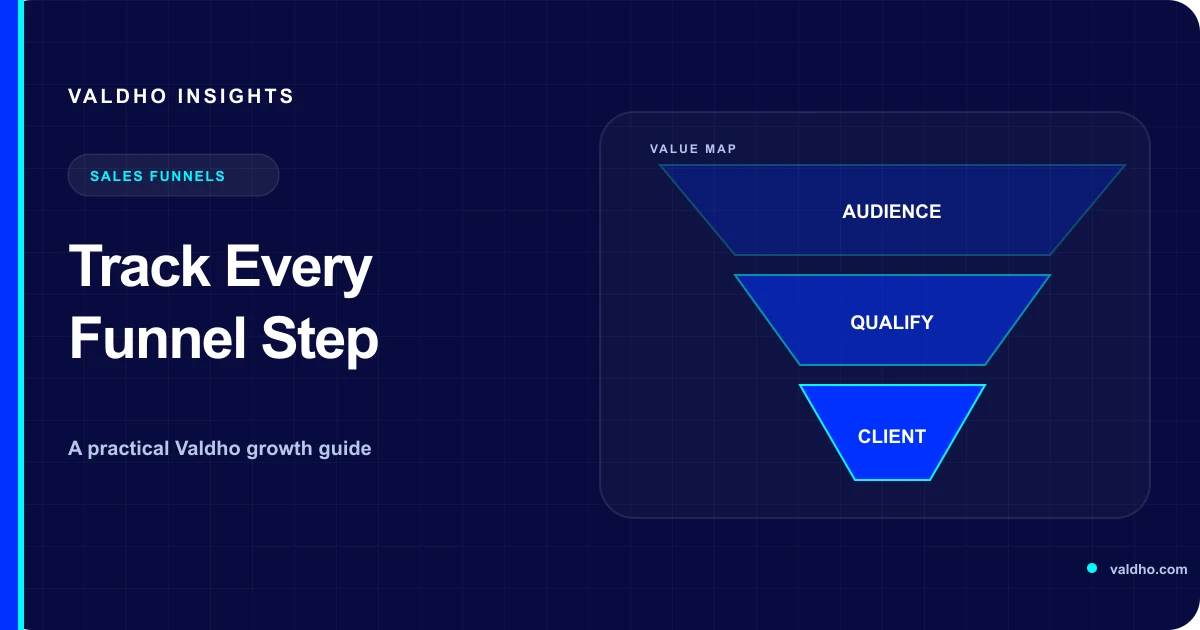
Google Ads conversion tracking for sales funnels starts with a decision: which verified customer action should count as success? For a consultant selling discovery calls, that might be a confirmed booking. For a B2B service team, it might be an enquiry that meets a documented qualification rule. Map those outcomes before installing tags, then give each action one clear trigger and one accountable owner.
Use this guide to plan a journey from landing page to enquiry, booking, and sales review. The event map and examples below are proposed operating rules, not customer results or performance guarantees. Your goal is a report the sales team can explain using actual records.
1. Write a conversion contract for each stage
Start by sketching your customer journey using the relevant Valdho funnel type. Next to each stage, write the evidence that proves it happened. A button press is an attempted action; a saved enquiry or confirmed calendar record is stronger evidence of completion. Keep those meanings separate in your measurement plan.
- Landing page viewed: diagnostic context; do not label it a lead.
- Enquiry accepted: the form passed validation and created a record; exclude failed submissions and internal tests.
- Meeting booked: a confirmed appointment exists; opening the scheduler is not sufficient.
- Lead qualified: an assigned reviewer applied the agreed fit criteria; a form answer alone may not establish this.
- Sale confirmed: use the payment or sales record that your business recognizes as the outcome, with an explicit cancellation policy.
For every action, record its name, source system, exact trigger, exclusions, unique record identifier, reporting owner, and intended campaign use. Add a correction rule: what should happen if a booking is rescheduled, an enquiry is rejected, or a sale is cancelled? Decide that before the team treats the dashboard as a final ledger.
2. Separate observation from bidding
Google's primary and secondary conversion guidance says primary actions appear in the Conversions column and are used for bidding when the campaign uses their standard goal. Secondary actions normally appear in All conversions for observation. There is an important exception: a secondary action included in a custom goal is used for bidding when that custom goal is selected.
For an initial consultation campaign, consider keeping scheduler opens as diagnostic events and using verified bookings as the target outcome. If qualification happens later, first establish a reliable way to report that stage. Do not switch the campaign to an outcome your team cannot produce consistently. This is a planning example, not a universal bidding prescription.
Google's conversion goals documentation recommends choosing only one account-default goal when multiple standard goals represent different stages of the same funnel. Review the actual goals selected by each campaign, including any campaign-specific or custom goals. An action's name alone does not tell you whether it influences bidding.
- Write the campaign's intended outcome in one sentence.
- List every conversion action included in the selected goal.
- Identify actions that represent the same underlying event through different sources.
- Keep preliminary steps available for diagnosis without automatically making them campaign targets.
- Record the date and owner of any goal change so later reports have context.
3. Choose one measurement route per outcome
Google's current web conversion setup guide supports website measurement through a Google tag or eligible events from a linked Google Analytics property. It distinguishes URL-based page-load tracking from code-based tracking for actions or dynamic data, and warns that duplicate tagging through third-party integrations can create duplicate reporting.
Inventory what already runs on the funnel: platform tracking settings, a tag manager container, manually inserted snippets, and Analytics imports. Assign one owner to the intended Ads measurement route for each business outcome. If you keep a second route for comparison, label it clearly and review its goal inclusion rather than assuming Google will combine separate conversion actions for you.
Use a confirmation URL only when reaching that page reliably represents the completed action. If a visitor can open it directly, reload it, or arrive after a failed submission, the URL alone is weak evidence. Prefer a completion event tied to the saved record where your implementation supports it. Confirm the available hooks with your platform or developer before promising a particular integration.
For a consultation journey, review the steps in an appointment funnel and specify where enquiry acceptance ends and booking confirmation begins. If scheduling occurs on another domain or inside an embedded tool, ask its owner how successful bookings are exposed to your chosen measurement route. Include that boundary in the test plan.
4. Set counting rules without hiding duplicate triggers
Under Google's conversion counting options, One counts one conversion per ad click for a conversion action, while Every counts each conversion after an ad interaction. Google presents One as useful for lead generation and Every for sales where each purchase adds value. The setting applies per action, so One is not a count of unique people across your entire funnel.
Choose the counting rule that matches the question your report answers. For an enquiry action, you may want to know whether an ad click produced an enquiry at all. For separate paid purchases, each completed order may matter. Still fix repeated triggers at their source: a counting setting is not proof that your form or event implementation works correctly.
For purchase tracking, Google's transaction ID guide explains using a dynamic, unique ID to reduce duplicate conversions for the same action. Reuse the order's ID when the same purchase is reported again, and use a different ID for a different purchase. Do not hard-code one shared value. Google explicitly distinguishes this safeguard from the One counting setting.
5. Test complete journeys before trusting totals
Google's tag verification instructions describe using Tag Assistant to check whether the Google tag is present and sending events to the intended destinations. Use it to inspect the technical path, then compare the observed event with your source record. A detected tag does not establish that your definition of a qualified lead is correct.
Build a small test log with a test-case name, expected business record, expected event, observed destination, result, and owner. Use an approved test environment or a documented test-data process. A debug session can verify event delivery without proving that a conversion will be attributed to a real advertising interaction.
- Valid enquiry: confirm one accepted record and the intended completion event.
- Invalid form: confirm validation prevents a success event.
- Repeated click or request: confirm the original action is not recreated.
- Confirmation refresh and direct visit: check that neither invents a new completed outcome.
- Booking abandoned: verify that opening or closing the scheduler is not treated as a booking.
- Booking rescheduled or cancelled: confirm the chosen business and reporting rules are followed.
- Mobile and external scheduler: repeat the journey through every domain or embedded step.
- Tracking preferences: test the behavior your team has specified for permitted and restricted measurement states; do not bypass a visitor's choice to obtain a count.
6. Diagnose the first point where evidence diverges
Work outward from the customer record. First establish that the action occurred and qualified for tracking. Then check that the event was created, routed to the intended action, and interpreted under the chosen reporting settings. Avoid changing the campaign while the underlying event is still uncertain.
- No source record: investigate the form or booking flow before the Ads report.
- Record exists but no observed event: inspect the completion trigger, preferences, and integration boundary.
- Event observed at the wrong destination: compare the configured account and conversion identifiers.
- Several events for one record: inspect overlapping snippets, containers, imports, and repeat page loads.
- Ads and CRM totals differ: compare stage definitions, exclusions, date basis, attribution settings, and reporting period before expecting equality.
- Many enquiries but few qualified conversations: review fit criteria and downstream outcomes before interpreting enquiry volume as business success.
7. Hand over a maintainable measurement checklist
Keep a short handover document beside the funnel plan. It should allow a colleague to understand what each conversion means and repeat the key tests after a page, form, scheduler, or tracking configuration changes. Use actual evidence from your own journey rather than a generic conversion-rate benchmark.
- Each tracked stage has a verified outcome, source system, owner, and exclusions.
- The campaign's selected goals match its intended business outcome.
- Primary, secondary, and custom-goal settings have been reviewed together.
- One measurement route owns each outcome, with comparison routes clearly identified.
- Counting rules and purchase identifiers match the business question.
- Success, failure, repeat, and cross-domain paths have recorded test results.
- Customer records and platform-attributed conversions are reported as distinct measures.
- An owner and review date are assigned for future funnel changes.
Ready to plan your enquiry-to-meeting journey? Compare Valdho plans with the funnel and operating needs you have documented. Bring your conversion map to the setup discussion and confirm the tracking method available for your chosen journey before committing campaign spend.
Put the playbook into practice
Build the journey and automate the next step with Valdho
Create pages, capture and qualify leads, automate follow-up, and measure conversion from one connected workspace.
Start 14-day trial