Sales Proposal Follow-Up Process: From Sent to Decision
Build a sales proposal follow-up process with clear owners, useful messages, decision dates, stop rules, and reporting for service businesses.
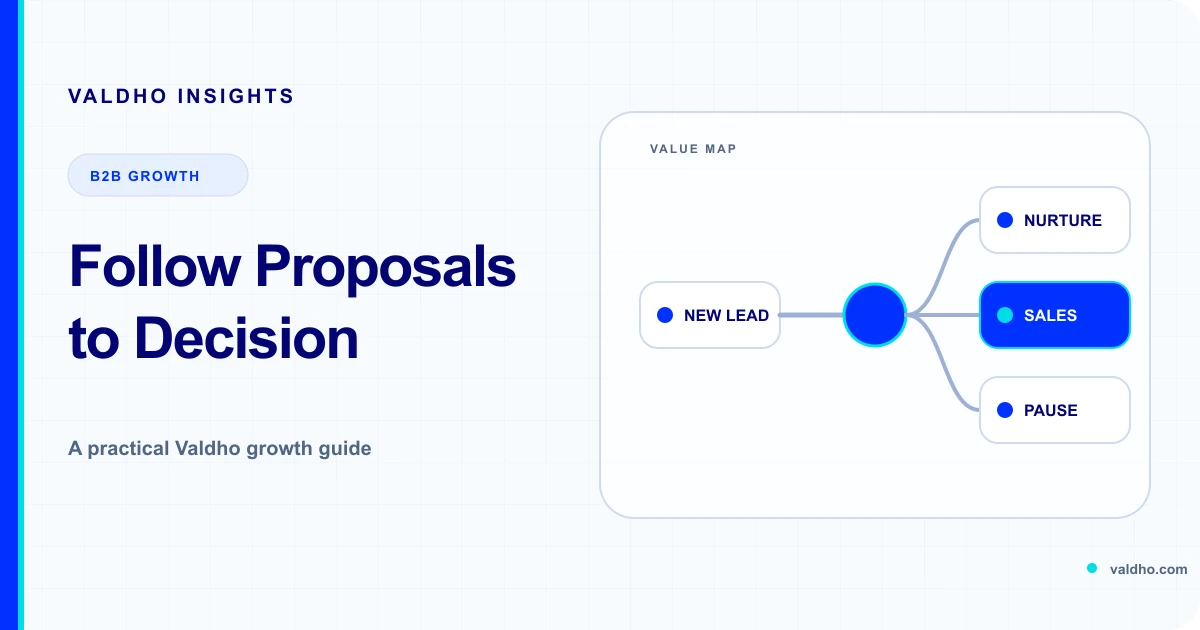
A sales proposal follow-up process is the agreed path from sending a proposal to recording a clear outcome. For a consultant, agency, coach, or B2B service provider, that path should help the buyer evaluate the work, surface unresolved questions, coordinate other decision-makers, and choose a next step. It should not depend on repeatedly asking whether the prospect has seen the document.
The practical goal is decision progress. Every follow-up should either confirm the review plan, remove a specific obstacle, arrange a useful conversation, revise an agreed part of the proposal, or close the opportunity with an accurate reason. This keeps the process respectful for the buyer and visible for the seller.
Start the follow-up process before sending the proposal
A proposal is easier to follow up when the buyer already understands why it is being sent, who will review it, and when a decision is realistic. Before delivery, confirm the business problem, desired outcome, proposed scope, commercial range, decision participants, and decision path. If those points are unknown, the document may be doing work that belongs in the sales conversation.
- Decision owner: the person responsible for confirming the final answer.
- Reviewers: people who must assess scope, delivery, finance, legal, or technical fit.
- Decision criteria: the outcomes, constraints, and risks the proposal must address.
- Review date: when the buyer expects to have discussed the proposal internally.
- Next conversation: a provisional time for questions or a final decision.
- Communication channel: the agreed place for questions, changes, and formal confirmation.
Use proposal statuses that describe evidence
Keep proposal follow-up statuses separate from vague activity labels such as contacted or warm. A useful status should tell another team member what the buyer has done, what is still unresolved, and what must happen before the opportunity moves.
- Proposal sent: the agreed document reached the named reviewers.
- Review confirmed: the buyer acknowledged receipt and confirmed the review path.
- Questions active: specific commercial, scope, delivery, or approval questions are open.
- Decision scheduled: the buyer named a decision meeting, deadline, or approval event.
- Revision agreed: both sides identified a defined change that could affect the decision.
- Closed won, lost, or deferred: the outcome and a useful reason have been recorded.
Salesforce Trailhead recommends mapping the revenue lifecycle to opportunity stages and asking what is required before an opportunity moves forward. Use that principle to define proposal statuses around observable buyer evidence. Review the current Salesforce guidance on stages and sales processes, then adapt the stage language to your own service and decision process.
Build the cadence around the buyer's decision date
There is no universal number of days that makes a proposal follow-up helpful. A one-person advisory engagement and a multi-stakeholder implementation purchase do not move at the same speed. Anchor timing to the review plan the buyer gave you, then use each contact for a different purpose.
- Delivery message: confirm what was sent, the agreed outcome, and the next scheduled step.
- Receipt checkpoint: use only when receipt or access has not already been confirmed.
- Review support: answer a known question or provide a requested decision aid.
- Decision reminder: refer to the buyer's stated date and ask whether the path has changed.
- Close-the-loop message: offer a clear choice to proceed, defer, decline, or request one defined revision.
Write every follow-up around one decision
A strong proposal follow-up is short because the context already exists. Restate the shared outcome, name the agreed review point, ask one answerable question, and make the next action easy. Do not attach a fresh sales pitch to every message.
- Context: name the proposal, problem, or outcome in one sentence.
- Evidence: refer to the agreed date, question, participant, or next step.
- Decision question: ask what must be answered or chosen now.
- Options: offer a call, written clarification, scoped revision, defer date, or close.
- Ownership: state who will do what next and by when.
Message 1: confirm the review plan
Subject: Proposal and review plan. Hi [Name], I have sent the proposal for [outcome]. It reflects the scope, timing, and responsibilities we discussed. You planned to review it with [participants] by [date], and we have [next step] pencilled in for [date]. If the document does not answer a question needed for that review, reply here and I will address it directly.
Message 2: remove one decision obstacle
Subject: Question before your proposal review. Hi [Name], when we spoke, [constraint or concern] was the main point to resolve. The proposal addresses it through [specific section or decision]. Is that enough for your review, or would a short call with [relevant person] help clarify it? I can make [two suitable options] work.
Message 3: close the loop without guessing
Subject: Next step for [project or outcome]. Hi [Name], we expected a decision after [event or date], but I do not want to assume the plan is unchanged. Which option is most accurate: proceed with the proposal, discuss one defined change, revisit after a specific date, or close the opportunity for now? Any answer helps me keep the plan and availability accurate.
Separate proposal communication from ongoing marketing
A requested proposal and its related decision conversation are not the same as permission for an indefinite promotional sequence. Keep operational proposal messages focused on the active request. If you also want to send newsletters, campaigns, or broader marketing, manage that purpose and permission separately.
For UK recipients, the Information Commissioner's Office explains that electronic marketing rules depend on whether a message is solicited, whether the subscriber is an individual or a corporate entity, and how contact details are used. Its current guidance also says senders must identify themselves and provide a valid opt-out address. Read the ICO electronic mail marketing guidance for the detailed distinctions before designing a UK campaign.
For commercial email in the United States, the Federal Trade Commission explains how CAN-SPAM applies, including accurate sender information, non-deceptive subject lines, identification requirements in relevant cases, a postal address, and a working opt-out process. Review the FTC's current CAN-SPAM compliance guide for business and obtain appropriate advice for the jurisdictions and message types you use.
Track buyer state, not just opens and clicks
An email open cannot prove that a proposal was understood, discussed, approved, or rejected. Treat communication activity as context. Let the CRM outcome depend on buyer statements and business evidence such as a confirmed review, a scheduled decision, an agreed revision, a signed agreement, a verified payment, or a clear decline.
- Last meaningful buyer response and its date.
- Current proposal status and the evidence supporting it.
- Named owner and next action date.
- Open question, reviewer, or approval dependency.
- Original and revised decision dates with the reason for change.
- Closed outcome and a short reason that supports future learning.
Google Analytics currently documents recommended lead-generation events including `working_lead`, `qualify_lead`, `close_convert_lead`, and `close_unconvert_lead`. Use those events only when your underlying business state supports them, and keep sensitive proposal detail out of analytics parameters. See Google's current recommended events reference before implementing event names and parameters.
Define stop, defer, and handoff rules
Automation should never keep sending proposal reminders after the buyer has answered, objected, opted out, selected another provider, or entered a sensitive negotiation that requires a person. Design stop rules before activating a sequence, and make ownership visible when a reply needs judgment.
- Stop when the buyer gives a final decision or asks for no further contact.
- Pause when a material question, complaint, negotiation, or scope change needs a person.
- Defer when the buyer gives a credible future trigger and date.
- Close stale when the documented contact limit is reached without a response.
- Reopen only when new buyer evidence changes the recorded outcome.
Give one person ownership of the next action
One opportunity can involve a salesperson, consultant, delivery lead, finance reviewer, and subject expert, but the next action still needs one accountable owner. Supporting people can answer questions without creating parallel follow-up threads. Record the owner, due date, and expected result where the team can see them.
- Sales owner maintains the decision path and closes the record accurately.
- Subject expert answers only the technical or delivery question assigned to them.
- Finance or legal reviewer handles agreed commercial or contractual points.
- Automation sends only approved messages while the opportunity remains eligible.
- A reply, objection, or material change routes back to the accountable person.
Measure whether the process creates clarity
Do not judge the process only by how many reminders were sent. Measure whether proposals reach a recorded decision, whether the promised next actions happen, and whether the team learns why opportunities move, defer, or close. Compare like-for-like offers and segments instead of turning one average into a universal benchmark.
- Proposals with a named decision owner and date before delivery.
- Time from proposal sent to review confirmed and final decision.
- Open proposals with an overdue or missing next action.
- Revisions requested, accepted, and declined by reason.
- Won, lost, deferred, and no-decision outcomes by offer and source.
- Follow-ups stopped correctly after replies, objections, and opt-outs.
Implement the process in seven steps
- Review recent proposals and identify where the decision path became unclear.
- Define proposal statuses using evidence that another person can verify.
- Create required fields for owner, reviewers, decision date, next action, and open question.
- Write one message for delivery, one for removing an obstacle, and one for closing the loop.
- Add stop, pause, defer, and human-handoff rules before any automation.
- Test happy paths, replies, revisions, delays, opt-outs, declines, and duplicate records.
- Review outcomes regularly and change the process only when the evidence supports it.
Sales proposal follow-up checklist
- The proposal reflects a problem, outcome, scope, and commercial conversation that already happened.
- The buyer's decision owner, reviewers, criteria, and expected date are recorded.
- Every follow-up refers to an agreed event or removes a specific obstacle.
- Messages offer clear choices instead of manufactured urgency.
- Marketing permission and operational proposal communication are handled appropriately.
- Buyer evidence, not email engagement alone, controls stage movement.
- Every open proposal has one owner and one dated next action.
- Replies, objections, opt-outs, and sensitive negotiations stop automation.
- Closed and deferred outcomes include reasons the team can learn from.
When your statuses, ownership, messages, and stop rules are ready, review Valdho's sales CRM and pipeline for stages, owners, deal value, notes, and follow-ups. Then explore workflow automation for reviewed email sequences, timing, lifecycle controls, and supported WhatsApp follow-up. Compare the exact users, workflows, channels, and reporting you need on the Valdho pricing page before choosing a plan.
Put the playbook into practice
Build the journey and automate the next step with Valdho
Create pages, capture and qualify leads, automate follow-up, and measure conversion from one connected workspace.
Start 14-day trial